Home Physiotherapy vs Clinic: Which Is Better for You?
Published on:
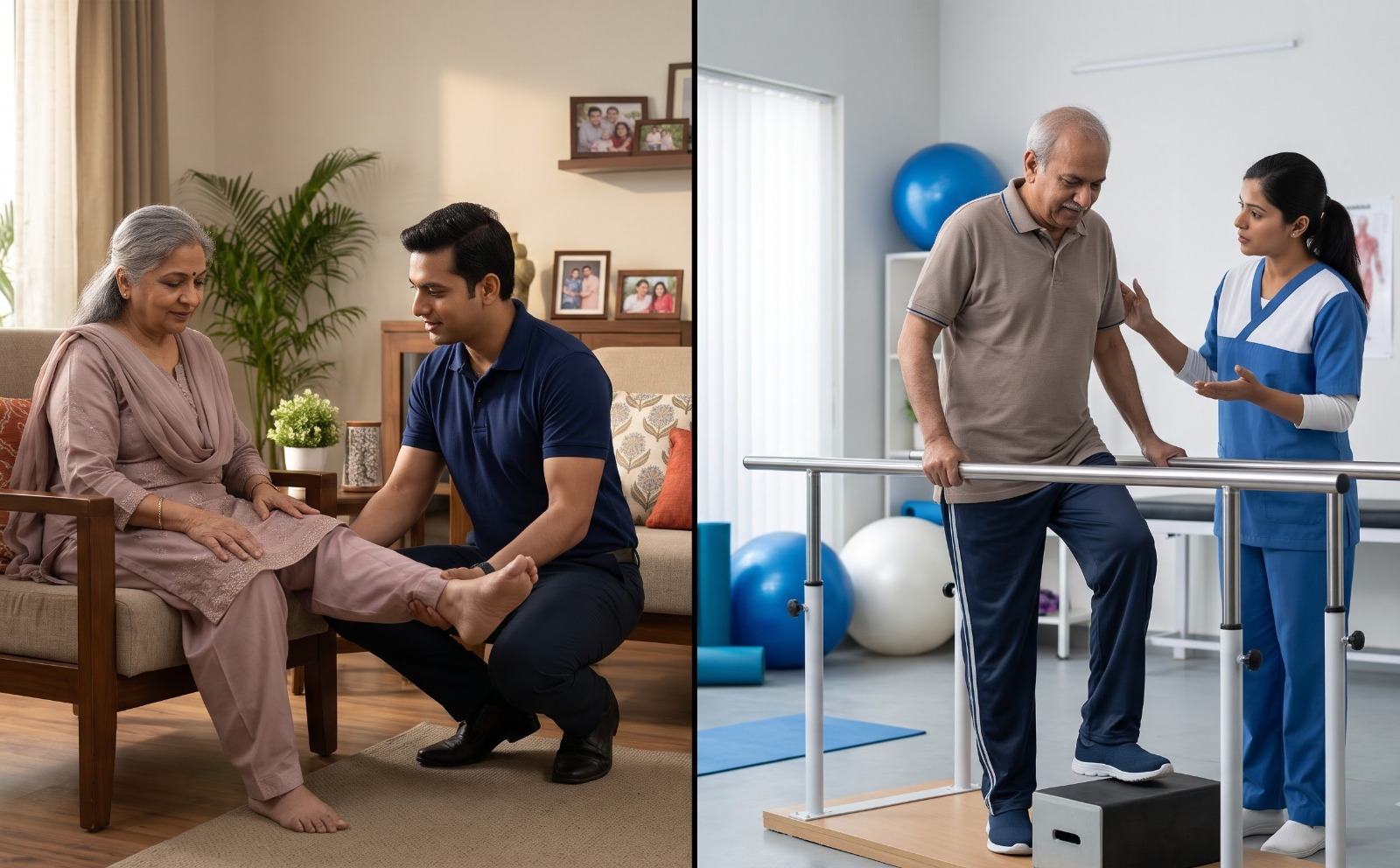
Choosing between home physiotherapy and a clinic is mostly a question of what you need and what you can manage, and the research gives a more balanced answer than either side's marketing. This guide compares home physiotherapy vs clinic care: what the evidence says, the pros and cons of each, who tends to benefit from home visits and what to ask before you choose. It draws on a systematic review of rehabilitation after knee replacement and the NHS overview of physiotherapy.
What the research shows
The strongest comparison located for this article looks only at rehabilitation after total knee replacement. The review pooled five randomised trials with 752 participants that compared clinic-based care with home-based programmes. Its findings:
- Walking ability (a 6 minute walk test) showed no clinically important difference at 10 weeks.
- Knee pain and function showed little or no difference at 10 or 52 weeks.
- There were no significant differences in quality of life or range of motion.
- One further trial compared inpatient rehabilitation with home programmes and found no better mobility or pain outcomes, although patients reported higher satisfaction with inpatient care.
The authors concluded that home-based rehabilitation may be an appropriate first-line option after uncomplicated knee replacement for people with adequate social support. They also noted the evidence is low to moderate in quality and based on few studies.
Two cautions apply. The result is about knee replacement, so it does not prove that home care works equally well for every condition. And a home programme in a trial is not always the same as a physiotherapist visiting your home, so use the finding as encouragement, not as proof.
Home vs clinic at a glance
The table below is general reasoning rather than evidence from the review, so adapt it to your situation.
| Consideration | Home physiotherapy | Clinic physiotherapy |
|---|---|---|
| Travel | None. Helpful if walking, stairs or transport are difficult | Needed each visit, which can tire people after surgery or a stroke |
| Familiar setting | Exercises are practised where they are needed, such as your own stairs and bed | Practised in a different setting, which may not match your home |
| Equipment | Whatever the therapist brings and your home allows | Often a wider range of fixed equipment |
| Supervision | One to one in your own space | One to one in a treatment room, sometimes with other patients nearby |
| Family involvement | Easier for a carer to watch and learn | Carers can attend but must travel |
Who may benefit most from home visits
Senocare's own FAQ describes its home service as suited to people with mobility issues, post-surgery recovery needs, or difficulty visiting a clinic. The research above supports home-based rehabilitation for people recovering from uncomplicated knee replacement who have adequate support at home. Senocare's service page lists range of motion exercises, electrotherapy, cryotherapy, heat therapy and ultrasound therapy among the treatments available at home, so many common treatments do not need a clinic. See the physiotherapy at home page for details.
When a clinic may suit you better
These are general considerations, not from the sources:
- You are mobile, travel is easy and you want access to a wider range of equipment.
- Your problem needs an investigation or equipment that cannot be brought to your home.
- You prefer a structured setting, or group sessions.
- There is no suitable space at home or no one to help if needed.
The NHS notes that physiotherapy can also be delivered by telephone or video, or in groups, so home and clinic are not your only options.
Questions to ask before you choose
- Is the physiotherapist qualified and registered, and can they tell me their qualifications?
- What will the first visit involve, and how many sessions do they expect?
- Which exercises will I do between sessions, and who checks my technique?
- What happens if my condition does not improve or I need a scan or a doctor's review?
- What are the fees per session, and what does that include?
Making the decision
If travel is the main barrier, home visits are a sensible starting point. If you are mobile and want equipment, a clinic may fit. Many people mix both as they recover. This article is general education and not a substitute for advice from your doctor or physiotherapist.
FAQs
For rehabilitation after uncomplicated knee replacement, one meta-analysis found no clear advantage for clinic-based care over home-based programmes. Evidence for other conditions was not reviewed here, so ask your physiotherapist about your case.
Senocare's service page lists electrotherapy and ultrasound therapy among treatments available at home. Check with the provider which devices they bring.
The NHS says physiotherapy can also be offered by telephone or video call, and in groups. Ask your provider whether this suits your problem.