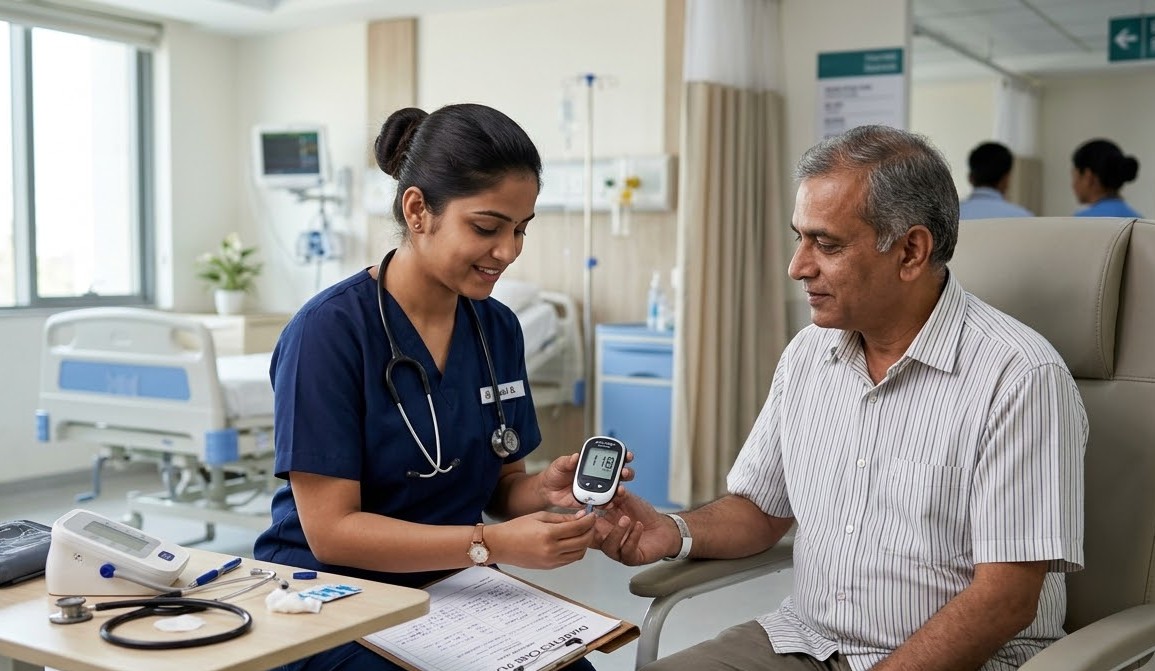
Nursing Care Plan for Diabetes: A Day Inside Senocare's Home Nursing Routine
Mr. Khanna's daughter called us on a Tuesday evening, and she wasn't calm.
Her father, 74, had been managing type 2 diabetes for almost sixteen years. He lived alone in Gurgaon; she lived in Singapore. For months, phone calls had been enough. "Papa, did you take your tablet?" "Yes, yes, I took it." That was the whole conversation, most days.
Then he fainted in his kitchen. A neighbour found him, sweating and confused, blood glucose at 48 mg/dL when the ambulance crew finally checked it. He recovered within the hour, but the message was clear: nobody around him actually knew what his diabetes was doing on a daily basis, including him.
That's the phone call that starts most of our diabetes care assignments at Senocare. Not a diagnosis. A scare.
Why a Care Plan on Paper Isn't the Same as Care at Home
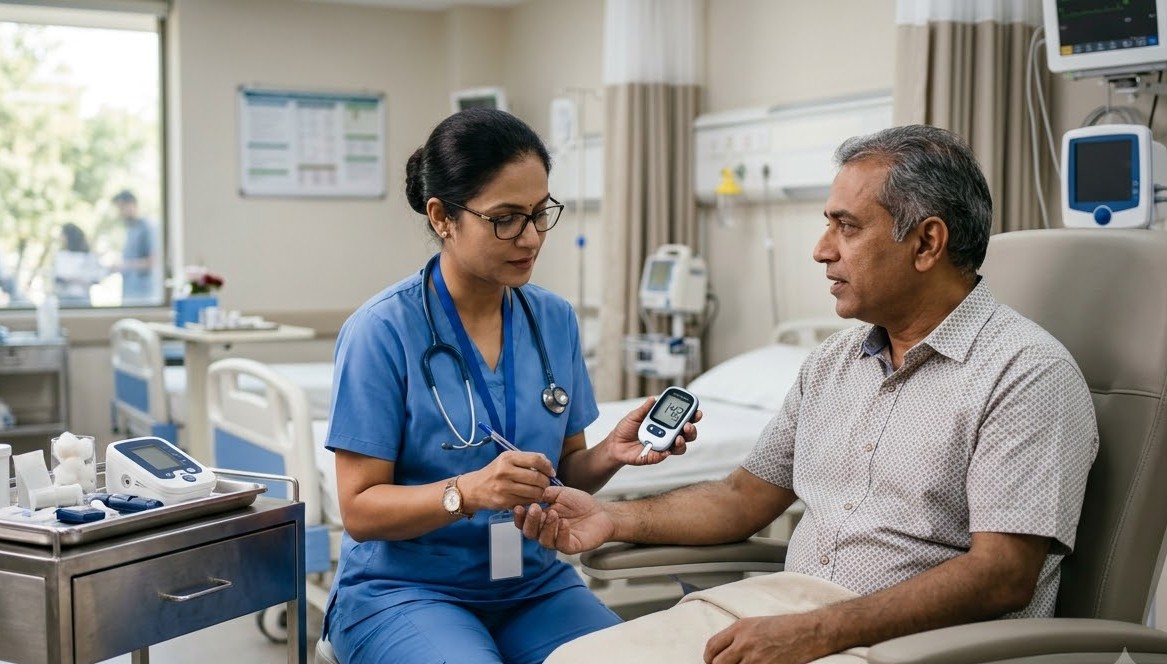
Most people, when they hear "nursing care plan for diabetes," picture something clinical: a hospital chart, a table of nursing diagnoses, maybe a printed sheet handed over at discharge. And structurally, that's accurate. A nursing care plan is a written framework that lays out a patient's problems, the goals of care, and the specific actions a nurse takes to get there.
But a plan sitting in a file folder doesn't check anyone's feet. It doesn't know that Mr. Khanna skips breakfast when he's not hungry and then takes his metformin anyway. It doesn't notice that his handwriting on the glucose log got shakier over the last two weeks.
Our nurses do. That's the gap Senocare fills for families managing diabetes in an ageing parent, particularly when that parent lives alone in Delhi, Noida, or Gurgaon, and family is either at work all day or on another continent.
The First Visit: Assessment, Not Assumptions
When our nursing team took on Mr. Khanna's case, the first visit wasn't about giving instructions. It was about finding out what was actually going on, which is the real starting point of any nursing care plan for a diabetic patient.
Our nurse went through the areas that matter most for an elderly diabetic patient:
- His diabetes history and how long he'd been on his current medication
- His most recent blood glucose readings and HbA1c, which reflects average blood sugar over roughly the past three months, not just a single reading
- What he was actually eating, versus what he thought he was eating
- His feet. Always the feet, in an elderly diabetic, because nerve damage means a wound can form without pain to announce it
- Whether he understood the difference between his tablets and what would happen if he skipped a dose
- How he was coping emotionally, since he'd been managing this largely on his own since his wife passed
What the Nursing Diagnosis Actually Told Us
Once the assessment was done, our nurse and the visiting doctor arrived at a working nursing diagnosis: risk for unstable blood glucose, related to inconsistent food intake and gaps in day-to-day monitoring, layered with deficient knowledge around what his early hypoglycemia symptoms actually looked like.
This is common. Elderly patients with diabetes for over a decade often assume they know their condition because they know the words: sugar, insulin, tablet. What they sometimes don't have is a felt sense of their own warning signs, especially when nobody's been watching closely enough to help them notice the pattern.
A published review of hospitalized diabetic patients found that unstable blood glucose is driven by a mix of physiological, treatment-related, and behavioural factors, not any single cause, which is exactly why a generic printout never fits a real person.
Building the Plan Around Mr. Khanna, Not Around Diabetes in General
Glucose Monitoring, Done Consistently
Our nurse checked and logged his blood glucose at set times, watching for the pattern, not just the single number. The American Diabetes Association's 2026 Standards of Care set a general target of 80 to 130 mg/dL before meals and under 180 mg/dL one to two hours after eating for most adults, though the exact target is always individualized to the patient's age and health status.
Medication, Administered and Reinforced, Not Just Handed Over
Our nurse made sure he took his tablets with food, at consistent times, and gently corrected the habit of skipping meals while still dosing.
Foot Checks, Every Single Visit
This one isn't optional in our protocol. Diabetic neuropathy raises the annual risk of a foot ulcer to 7 to 10 percent on its own, and up to 25 to 30 percent when circulation problems are also present, and around 85 percent of diabetes-related lower-limb amputations start as a foot ulcer that went unnoticed.
Mr. Khanna had a small callus starting on his heel in week three. Caught early, it was managed with proper footwear and moisturizing before it became anything worse.
Recognizing Hypoglycemia Before It Becomes an Emergency
Our nurse taught him, patiently and more than once, the rule of 15: if his glucose drops below 70 mg/dL, or he starts feeling shaky or sweaty, he takes 15 grams of fast-acting carbohydrate, waits 15 minutes, and rechecks. If still low, he repeats it.
Nutrition, Adjusted to What He'd Actually Eat
No generic diet sheet. Our nurse worked around his preference for simple home food, focusing on consistent meal timing and portion awareness rather than an overhaul he'd abandon in a week.
Why This Matters More in India Than the Numbers Alone Suggest
Diabetes in India isn't a rare condition creeping up on a few unlucky people. India has an estimated 77 million adults living with diabetes, and this is projected to climb toward 100 million by 2030, with roughly 57 percent of cases currently undiagnosed.
Among people over 65, the number affected was estimated at 12 million in 2019 and is expected to reach 18 million by 2030.
Behind every one of those numbers is a version of the Khanna family's situation: an ageing parent managing a chronic condition, and adult children who are either too far away or too stretched to catch the small warning signs in time. A nursing care plan on a hospital form doesn't solve that distance problem. A nurse who shows up, notices the callus, checks the glucose log, and calls the family with an honest update does.
Evaluation Isn't a One-Time Thing
Six weeks in, we reassessed. Mr. Khanna's glucose readings were staying closer to his target range. He could explain, in his own words, what a low reading felt like and what to do about it. The callus on his heel had resolved. His daughter, from Singapore, started getting a short weekly update instead of a monthly worry spiral.
That's what evaluation actually looks like in a nursing care plan: not a box ticked once, but a routine that gets checked and adjusted, visit after visit, based on what's changing in the patient, not what the textbook assumes.
How Senocare's Team Approaches Diabetes Care at Home
If there's one thing this case shows, it's that a nursing care plan for diabetes only works when someone is actually present to carry it out consistently. That's the role our team plays for families across Delhi, Noida, and Gurgaon:
- Trained nurses who handle glucose monitoring, medication administration, and foot checks as a routine part of every visit, not an afterthought
- A dedicated Care Manager assigned to each family, so updates go to one person instead of getting lost between multiple providers
- Coordination with doctors for home visits and follow-up, so a growing problem gets flagged before it becomes a hospital admission
- Patient education that's repeated and practical, not a one-time pamphlet handed over and forgotten
- Flexible care hours, built around what the patient actually needs, whether that's a daily check-in or more comprehensive support
If you have a parent managing diabetes on their own, or a family member who's had a scare like Mr. Khanna's, this is the kind of steady, hands-on care we build around them.
You can learn more about Senocare's home nursing services here →
A Care Plan Is a Living Thing, Not a Form
The version of "nursing care plan for diabetes" that shows up in textbooks, tables, nursing diagnoses, expected outcomes, isn't wrong. It's the skeleton. What actually keeps someone like Mr. Khanna safe is the person applying it every day: noticing what changed since the last visit, adjusting instead of repeating the same instructions, and staying present enough to catch the small things before they become emergencies.
That's the work. Not the paperwork behind it, but the nurse who shows up and actually looks.