Flying After Knee Replacement: When It’s Safe and How to Prepare
Published on:
Quick answer
- Your surgeon decides when you can fly. No blog, airline or travel agent can set that date for your parent.
- Published surgeon and guideline advice varies a lot. Some surveyed surgeons are comfortable with short flights within weeks, while others advise waiting up to about six months for longer ones.
- The main concern is a blood clot in the leg (DVT). Surgery plus a long, cramped flight adds to that risk, so planning around movement, seat choice and anything your surgeon prescribes matters.
- Book an aisle seat and airport wheelchair assistance, carry medicines in hand luggage, and tell security about the implant.
- Calf pain or swelling, chest pain or breathlessness after a flight needs urgent medical care.
This is general information, not medical advice. It can’t replace your own surgeon’s instructions.
Here’s a conversation I hear a lot. A daughter in Gurgaon calls and says, “Papa’s knee surgery went well. There’s a cousin’s wedding in Pune in two months, or maybe a trip to see his grandchildren abroad. Can he fly?” And the honest answer is, “That’s a question for his surgeon, and here’s how to get a useful answer.”
Wanting to fly after a knee replacement is completely reasonable. Families get together, weddings happen, grandchildren grow up fast. The goal isn’t to scare you off. It’s to help you ask the right questions, prepare properly, and spot trouble early.
Who decides when it’s safe to fly?
Your surgeon does. They know which kind of surgery was done (total or partial knee replacement), how the wound healed, how well your parent is walking, and whether other things raise the clot risk, such as a previous clot, heart or lung conditions, or being overweight.
There’s also a good reason the answer isn’t a single number. A 2023 survey of UK hip and knee surgeons published in Cureus found no consensus on when flying is “safe”. The authors reported that there are no evidence-based guidelines on the question, and they encouraged surgeons to document each patient’s individual risks.
So when someone online says “you can fly after exactly X weeks”, treat it with caution. That’s a rule of thumb at best.
What the general guidance looks like (and why it varies)
You’ll see ranges quoted. Here’s what I could confirm from published sources, and how to read them.
| Source | What it reported | How to read it |
|---|---|---|
| UK surgeon survey (Cureus, 2023), patients without extra clot risk factors | Short-haul flights advised after 14 to 180 days (median 45). Long-haul flights (over four hours) advised after 35 to 180 days (median 90). | The spread is huge. Different surgeons, different comfort levels. |
| Same survey, patients with one or more clot risk factors | Short-haul advice 14 to 180 days. Long-haul 42 to 180 days. Median 90 days for both. | More risk factors tend to mean more caution. |
| Same survey, airlines that replied | Some airlines set restrictions of 7, 10 or 14 days after surgery; some asked for medical certification. | Airline rules are separate from your surgeon’s advice, and can differ. |
| NICE guidance (as described in that same paper) | Avoid long-haul flights for three months; short-haul may be possible after six weeks. | The paper notes this rests on low-level evidence. It’s a guide, not a promise. |
| US CDC travel clot advice | Travel of more than four hours raises clot risk, and recent surgery or injury (within 3 months) is listed as a risk factor. | Helps explain why longer flights get more caution. |
What this tells you: short flights are generally treated more cautiously than “never”, longer flights are usually treated with more caution, and your surgeon’s judgement on your parent’s body overrides every number in that table. If your surgeon says wait longer, wait longer.
If you’d like to see what the recovery itself looks like, we’ve covered what recovery looks like week by week in a separate post, so I won’t repeat the exercises here.
Why blood clots are the main worry
After knee surgery, the leg is swollen and moving less than usual. Sitting still for hours in a narrow seat adds to that. Together, these raise the chance of a deep vein thrombosis (DVT), a clot in a deep leg vein. If part of a clot travels to the lungs, it becomes a pulmonary embolism, which is an emergency.
The NHS travel-health pages describe the absolute risk from a long flight as very small for most people, but higher when there are existing risk factors, and they list recent surgery as one of them. They recommend people with such risk factors speak to their doctor before travelling.
What surgeons commonly advise
These are the usual themes in NHS and CDC travel guidance. Whether any of them apply to your parent is for the surgeon to say.
- Keep moving. The CDC suggests walking around and moving your legs every one to two hours on long trips. NHS advice is similar: move as much as you can.
- Flex and extend the ankles while seated.
- Stay hydrated, which also gives a natural reason to get up and walk to the toilet.
- Go easy on alcohol, sleeping tablets and tranquilisers, because they can stop you moving around.
- Compression stockings: only if the surgeon or doctor recommends them. NHS advice notes that stronger compression needs proper measuring and fitting, because an incorrect fit can raise risk rather than lower it. Don’t buy a pair off the shelf and assume they’re right.
- Blood thinners: only if prescribed. Never start, stop or change them on your own, and never “borrow” someone else’s. If your parent already takes one, follow the surgeon’s instructions on timing, especially across time zones.
Choosing your seat and booking help
A knee that’s still healing needs room and easy exits. Practical choices go a long way.
- Aisle seat. The NHS advises an aisle seat because it makes getting up and moving easier. It also means your parent doesn’t have to climb over two strangers to stretch.
- Extra legroom or bulkhead row. More room lets the knee stay a little straighter and gives space for the occasional stretch. Check with the airline, since bulkhead seats can have restrictions (for example, on armrests that don’t lift, or on who may sit there).
- Keep cabin bags out from under the seat in front so feet and ankles can move freely. The NHS specifically warns against luggage that restricts leg movement.
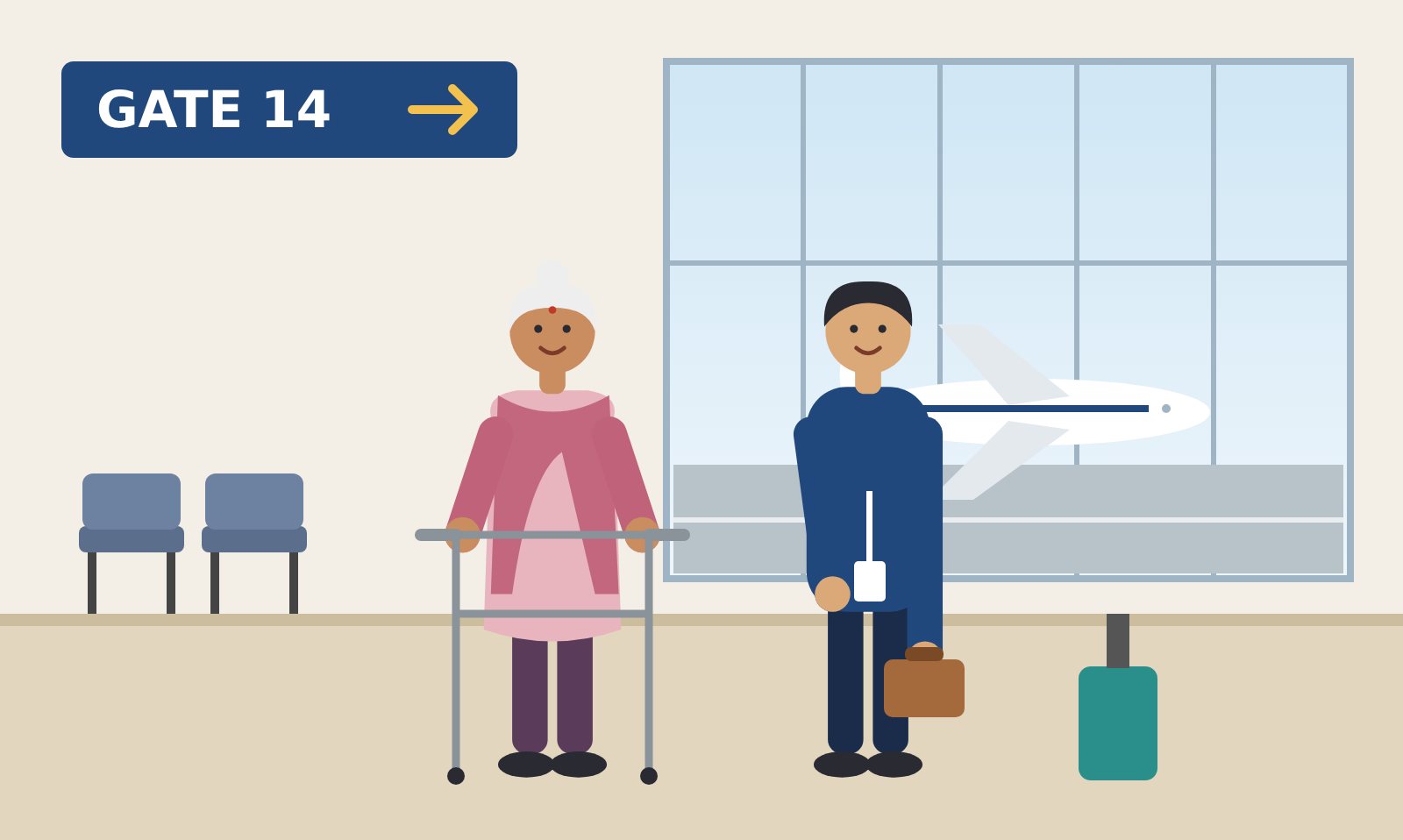
- Book special assistance (wheelchair) at the time of ticketing. Even if your parent can walk with a stick, airports are big. Long walks to the gate, queues and boarding crowds are tiring, and tired legs swell. Wheelchair assistance can usually be requested through the airline when you book. Confirm it again a few days before the flight.
- Allow generous connection times. On a trip with a change of flights, a tight layover is a recipe for rushing. A longer gap lets your parent walk slowly and rest.
If you’d rather not juggle this alone, our travel and tours team handles air, train and hotel booking for seniors, so seat and assistance requests can be sorted when the ticket is booked.
Airport security and a metal implant
Many people worry about this more than anything else, and it’s usually simpler than expected.
- An orthopaedic society page (AAHKS) states that a large majority of joint implants, over 90% for total hip and knee devices, set off metal detectors, so an alarm shouldn’t surprise you.
- Tell the security officer before screening begins that your parent has a knee implant, and point to where it is.
- Expect extra screening, possibly with a hand-held wand or a pat-down around the knee. One hospital guide notes you can usually ask for a private screening and don’t have to show your scar or remove clothing.
- An implant card: Ask your surgeon’s office whether they provide one. A joint-replacement ID card is commonly recommended by hospitals. The AAHKS page says the TSA doesn’t actually require a card or note, but carrying one does no harm and can help the conversation. Rules at Indian airports and in other countries can differ, so check with your airline before you travel.
- Allow extra time. Rushing a person who walks slowly is how stumbles happen.
Medicines, pain control and swelling
Medicines in hand luggage
- Keep all regular and post-surgery medicines in hand luggage, never checked luggage. Checked bags get delayed or lost.
- Carry them in original packaging with the prescription or a doctor’s letter listing medicines and doses.
- Pack extra for a few days beyond the trip, in case of delays.
- Carry a list of the medicines, the knee surgery date, the implant details and the surgeon’s contact number.
Pain control timing
- Ask the surgeon whether pain medicine should be taken before the flight or at set times during it, rather than waiting for pain to build up. Stiffness and pain at 35,000 feet make people stop moving, which works against everything above.
- If your parent takes any medicine that causes drowsiness, ask whether it’s wise to take it in flight. As above, sedation can reduce movement.
Swelling
Some leg and ankle swelling is common while the knee recovers, and sitting for long stretches can make it more noticeable. Expect it to be worse at the end of the day. What matters is a sudden or one-sided change, which we cover in the warning-signs section below.
Stretching in your seat
Keep this gentle and only if your surgeon has said it’s fine. These are simple, small movements, not a workout.
- Ankle pumps: while seated, point your toes up toward you, then down, slowly. Repeat for a minute or so, several times through the flight.
- Ankle circles: gently draw circles with your foot in each direction.
- Seated calf raises: with feet flat on the floor, lift your heels slightly and lower them back down.
- Walk the aisle every hour or two if the seatbelt sign is off and the surgeon is happy with walking.
Set a quiet reminder on a phone or watch so nobody forgets. Don’t push into pain, and stop if anything feels wrong. Anything beyond these small movements, such as a knee-bending routine, is something to clear with the surgeon or physiotherapist first.
Cabin pressure and long-haul flights
Aircraft cabins are pressurised, but not to sea-level conditions, and the air is dry. In practice, that’s another reason to keep drinking water. A few other considerations:
- Longer flights mean longer periods of sitting, and the CDC points to travel over four hours as where clot risk rises. The surgeon-survey figures above also show that surgeons are generally more cautious about long-haul trips.
- For an international trip, think about breaking the journey if possible, such as a stopover with a night’s rest and a few walks, rather than 20 hours in transit. Whether that suits your parent is for the surgeon to say.
- Time zones can scramble medicine schedules, so ask the surgeon or pharmacist how to handle doses.
- Check the travel insurance fine print. In the survey paper, insurers’ restrictions after joint replacement ranged from none to up to two years, and most said they’d consider clot-related claims if the surgery was disclosed when the policy was arranged. Always disclose the surgery. Senocare’s travel desk can also help with travel insurance as part of trip planning.
Trip timeline: before, during and after
| Stage | What to do |
|---|---|
| Before booking | Ask the surgeon whether and when flying is okay for your parent. Ask about flight length limits. Check the airline’s own rules on recent surgery. Disclose surgery to the insurer. |
| 1 to 2 weeks before | Book aisle or extra-legroom seat. Request wheelchair assistance. Get a doctor’s letter and implant card if available. Ask about stockings or blood thinners (only if the surgeon wants them). Arrange a physiotherapy check if the surgeon or therapist advises one. |
| Day before | Pack medicines, letter and prescriptions in hand luggage. Choose loose, comfortable clothing and easy slip-on shoes. Charge the phone and keep the surgeon’s number handy. |
| At the airport | Arrive early. Use wheelchair assistance. Tell the security officer about the implant. Keep ID, boarding pass and medicines easily reachable. |
| In flight | Do ankle pumps and calf raises regularly. Walk when allowed. Drink water, go easy on alcohol. Take pain medicine as the surgeon advised. Don’t sit with legs crossed for long. |
| After landing | Take it slow when getting off. Use assistance again if needed. Rest the leg, keep walking in short bouts. Watch for warning signs (below) over the following days and weeks. |
| Back home | Book a surgeon or physiotherapy review if anything feels off, or as the surgeon advised. |
Questions to ask your surgeon
Bring this list to the next review. Writing the answers down helps, especially if you’re the one booking the tickets.
| Question | Why it matters |
|---|---|
| Is flying okay for me at this stage, and for how long a flight? | The only answer that counts. Mention the planned route and duration. |
| Do I have any clot risk factors? | Past clots, heart or lung conditions, weight and medicines can change advice. |
| Do I need compression stockings or blood thinners for the flight? | Only if prescribed. Ask what type, how long and who fits them. |
| When should I take pain medicine around the flight? | Avoids pain building mid-flight. |
| Which in-seat movements are safe for my knee? | Confirms ankle pumps and calf raises are fine for you. |
| Can I have a letter or implant card for the airline and security? | Many families find paperwork useful. |
| Which symptoms mean I should seek care urgently, and where? | Especially if you’ll be travelling far from your surgeon. |
| Is there anything I should avoid at the destination? | Stairs, uneven ground, long walks, swimming pools. |
Warning signs after flying: don’t wait
Clots can show up during or in the days and weeks after travel, and the CDC notes that about half of people with a DVT have no symptoms at all. So watch closely and don’t brush things off.
Get urgent medical help if you notice:
- Calf pain, tenderness or swelling, especially in one leg and worse than the other leg
- Warm, red or discoloured skin on the leg
- Chest pain, particularly if it’s worse with a deep breath
- Sudden breathlessness, a racing heartbeat, coughing (including blood), or feeling faint
Leg swelling that’s worse on one side, or any breathing difficulty, should be treated as urgent. Call an ambulance or go to the nearest emergency department. Don’t wait for the next appointment, and don’t “see how it goes” overnight. Also contact the surgeon if the wound looks red, leaks fluid, or you have a fever.
How Senocare can help
Two kinds of help matter most around a flight after knee surgery.
Physiotherapy at home. A healthy, mobile knee makes travel easier. Our home physiotherapists support recovery after knee replacement, and a CareManager can coordinate the sessions. If you’re in Delhi NCR, see our page on physiotherapy at home in Gurgaon, or read more about physiotherapy for elderly parents. Because fall prevention matters in busy airports and unfamiliar hotels, our guide on fall prevention exercises for seniors is worth a look too.
Travel arrangements. The Senocare travel team can help with passport services, visa assistance, air, train and hotel booking, forex, car rental, a driver on call, travel insurance and escorted tours. For a broader look at planning, see our guide on travelling with parents.
If you’d like to talk it through, contact us or explore our care packages. We can’t tell you when your parent can fly, but we can make the planning around your surgeon’s advice a lot less stressful.
Frequently asked questions
Only your surgeon can say. Published advice varies widely. In one UK surgeon survey, suggested waiting times for short flights ranged from about two weeks to six months, and for long flights from about five weeks to six months. Your individual risk factors and recovery decide the answer, so get your surgeon’s go-ahead in writing if you can.
Flying isn’t automatically dangerous, but surgery plus long periods of sitting raises the chance of a blood clot in the leg. For most people the absolute risk from a flight is described as small, but it’s higher after recent surgery. Following your surgeon’s plan on timing, movement and any prescribed medicine is how families reduce that risk.
Quite possibly. An orthopaedic society page says over 90% of total hip and knee implants trigger detectors. Tell the officer before screening, point to the knee, and expect a wand or pat-down. A joint implant card from your surgeon can help, though one source says it isn’t strictly required. Check local airport rules.
Only if your surgeon or doctor says so. NHS guidance says stockings may be recommended for people at higher risk, and that they must be the right type and size, because a poor fit can raise risk. Blood thinners are prescription medicines. Never start or stop them yourself.
An aisle seat is usually the most practical, since it makes it easier to get up and move. Extra legroom or a bulkhead row can give more room for the leg, though bulkheads have rules, so check with the airline. Also request wheelchair assistance when you book to save energy for the flight itself.
Calf pain or swelling (especially in one leg), warm or red skin on the leg, chest pain, sudden breathlessness, a racing heartbeat or coughing blood all need urgent medical care. Don’t wait for an appointment. Go to the nearest emergency department or call an ambulance. This is general information, not medical advice. Always follow your own surgeon’s guidance about when and how to fly.