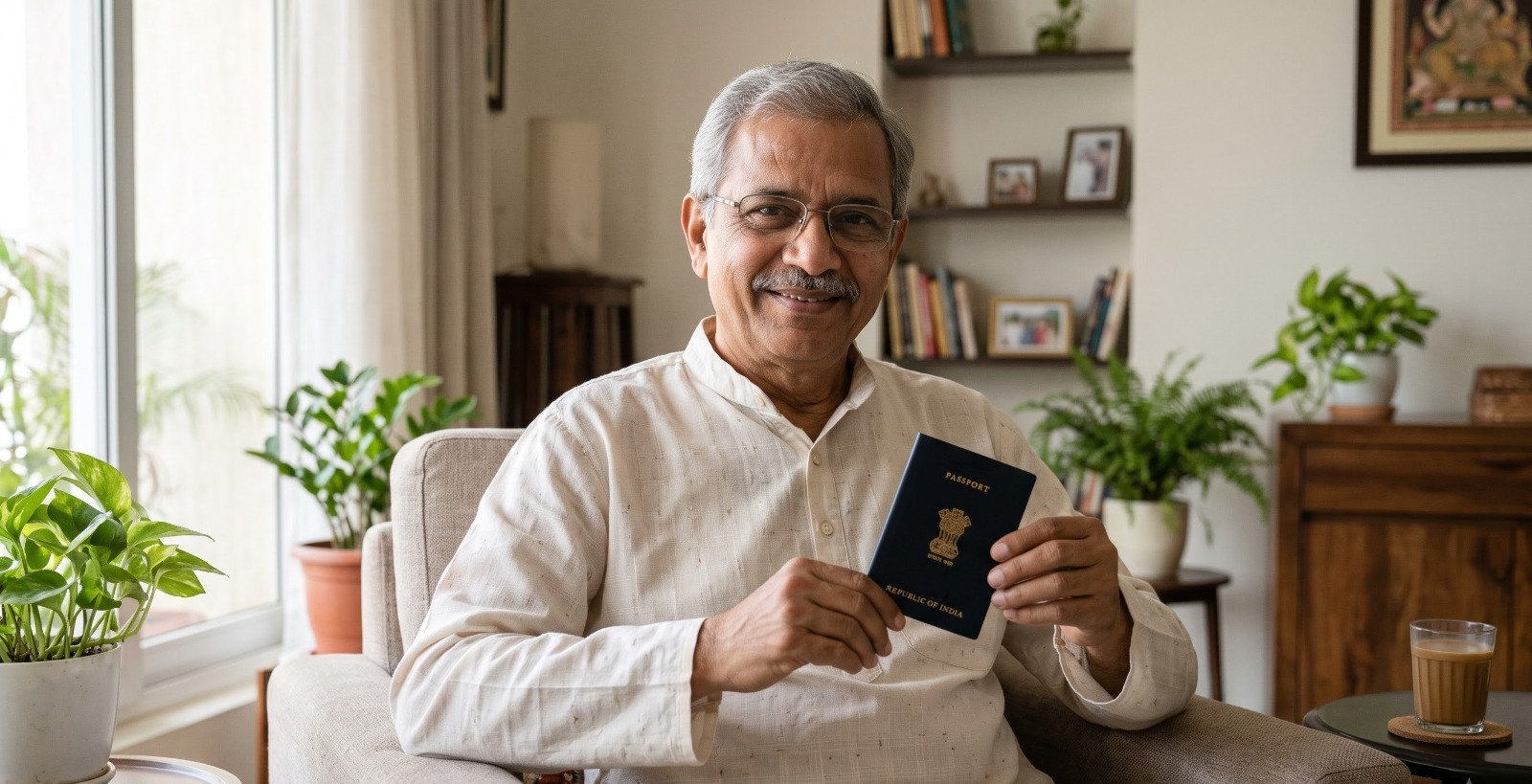
Foreign Exchange for Senior Citizens Travelling Abroad: Forex Cards vs Cash
Published on:
Your father has his passport, the visa is stamped, and the tickets are booked. Then he asks a quiet question: “Beta, paisa kaise le jaun?” How do I carry the money?
It sounds small. It isn’t. Money is the one part of a trip abroad that a senior can’t fix with a smile and a few gestures. A card that gets declined at a hotel counter, an ATM that eats a PIN, a stranger who offers to “help” at a machine: these are the moments that turn a holiday into a worry.
This guide covers forex for senior citizens in plain language: what to carry, how to buy it, what the rules say, and the habits that keep money safe. For the wider planning side (health, flights, hotels, pacing), see our broader guide on travelling with parents. Here, we stay with money.
Quick answer
- For most seniors, a mix works best: a forex prepaid card as the main spending tool, a small amount of cash for tips and small shops, and one international debit or credit card kept separately as backup.
- Buy only from an authorised dealer (an AD bank, or an authorised money changer). Carry your passport, ticket and visa details.
- Don’t put everything in one place. Split cards and cash between two people or two bags.
- Never share an OTP or PIN, even with someone who looks helpful.
- Rules on limits and tax change from time to time. Confirm with RBI or your bank before you buy. This post is general information, not financial or tax advice.
The four ways to carry money abroad
Before the table, a quick feel for each option.
- Forex prepaid card: You load foreign currency on a card in India, then tap or swipe abroad. It works like a prepaid debit card.
- Cash (foreign currency notes): Physical dollars, euros, pounds and so on, bought before you leave.
- International debit or credit card: Your normal bank card, enabled for use abroad.
- Remittance to a relative abroad: Money sent through a bank to a family member at the destination, who then helps your parent. Only suitable where there is a relative there, and it must go through the bank’s proper process.
Comparison table
| Factor | Forex prepaid card | Cash | Debit / credit card | Remittance to relative abroad |
|---|---|---|---|---|
| Safety | Good. Can be blocked if lost; PIN-protected | Weakest. Lost or stolen cash is gone | Good. Can be blocked; fraud monitoring varies by bank | Good for the sender; depends on the relative’s handling |
| Ease for seniors | Easy once set up; PIN and contactless need practice | Easiest to understand, hard to carry in volume | Easy, but OTP and international-use settings can trip people up | Easy for the senior, if the relative is nearby and reliable |
| Fees | Card issue, reload and ATM charges may apply; rate on the day matters | Margin built into the buying rate; no further fee, but poor rates at airports are common | Foreign transaction fee and currency markup are common | Bank remittance charges and the exchange rate used |
| Acceptance | Widely accepted where the card network is accepted | Accepted nearly everywhere, but some places prefer cards | Widely accepted; some small shops are cash-only | Not applicable; the relative pays or hands over cash |
| Refund of unused balance | Usually possible through the issuing bank; check timelines and any charges | Re-selling notes back is possible but rates are poor | Nothing to refund; you pay the bill later | Not applicable |
| If lost | Block immediately through the bank helpline; replacement card process varies | Little recourse | Block immediately; replacement process varies | Not applicable |
The cells that say “varies” are deliberate. Every bank has its own fee schedule and replacement process, so ask for it in writing before buying.
How to buy forex in India
Forex can be bought from authorised dealers. The RBI describes these as Authorised Dealer (AD) banks and certain authorised money changers. Buying from an unofficial vendor, a “friend who has dollars” or a street shop is risky and may break the rules.
What you’ll usually be asked for
- A valid passport.
- Proof of travel: a ticket or itinerary, and a visa where one is needed.
- PAN card.
- Address proof.
- A forex application form (some banks call it Form A2, which states the purpose of the purchase).
- For non-account holders, some banks add identity verification, such as video KYC.
Requirements differ between banks. Check the list on your bank’s website or call before you travel, so your parent doesn’t stand in a queue and then get sent home for a missing paper. If the paperwork feels like a maze, our form filing support can help with the documents side.
Can a child buy forex for a parent?
Short answer: it depends on the bank and the dealer. The traveller’s own identity and travel documents are generally needed, because the forex is bought for that traveller’s trip. Many banks accept the son or daughter coming to the branch with the parent’s documents, or ask the parent to complete KYC separately, and money for the purchase may come from the child’s account. But practice varies. Ask your bank these three questions:
- Can I pay from my account for a purchase in my parent’s name?
- Does my parent need to be physically present, or can KYC be done through video?
- Whose PAN will the transaction be recorded against?
That last one matters for the limit and tax points below.
The rules you should confirm: LRS, cash and declaration
Here are the facts we could confirm from official and reputable sources. Re-check them before you buy, since these can be updated.
LRS in one paragraph
The Liberalised Remittance Scheme lets resident individuals remit up to USD 250,000 a year for permitted purposes, including travel. According to the RBI’s FAQs, this limit applies to the individual, and foreign exchange bought for private travel counts within it. A senior’s trip usually sits well inside the limit, but your bank will still record the purchase.
Cash limits for travel
The RBI FAQ states that, for most destinations, foreign currency notes and coins up to USD 3,000 per visit can be taken, and the balance should go as a card, traveller’s cheque or draft. Some countries have different limits. Check the destination against the RBI FAQs or ask your AD bank. Also note the rules on Indian rupees leaving the country and on declaring foreign currency when returning. We couldn’t confirm the current customs thresholds from an up-to-date official page, so confirm with the Customs department or your bank. Don’t rely on old forum posts.
Unused money after you return
The RBI FAQ says unspent foreign currency notes and traveller’s cheques should be surrendered within 180 days of return, with a small allowance that can be retained. Confirm the current allowance with your bank. Forex cards can usually be refunded through the issuing bank.
TCS basics (facts only, not tax advice)
TCS is “tax collected at source.” The bank or tour operator adds it at the time of the transaction, and it is usually adjustable when income tax is filed. From what we found in reports of the 2026 Budget and the Income-tax Act 2025 (in force from 1 April 2026):
- TCS on overseas tour packages was reported as cut to a flat 2%, with no amount threshold.
- TCS on LRS remittances for education or medical treatment was reported as 2%, above a Rs 10 lakh threshold per person per financial year.
- Other LRS purposes (investment, gifts and so on) were reported at 20% above that threshold.
- PAN is needed, and TCS can be higher if PAN is not given.
We found these figures in press and tax-blog coverage rather than the Finance Act text itself, and how TCS applies to a small forex card purchase for a holiday can depend on how the transaction is classified. Please ask your bank or a chartered accountant what applies to your parent’s purchase. Our team can’t give tax advice.
Spotting costly rates
Two quiet charges eat into a senior’s holiday money.
Rate markup. Every dealer sells at a rate slightly above the market rate. The gap is their margin, and it varies a lot. Airport counters and hotel desks are often costlier than banks or specialist dealers, though not always.
Dynamic currency conversion (DCC). At a shop or ATM abroad, the machine may ask: “Pay in rupees or local currency?” Choosing rupees sounds friendly, but the conversion is done by the merchant’s bank at a rate that’s usually poorer. Always pick the local currency.
A simple way to compare:
- Ask for the all-in cost in rupees for the same foreign amount from two or three dealers.
- Ask about issue fees, reload fees, ATM fees, inactivity fees and refund charges.
- Check how the final rate compares with the day’s published rate.
“How much in which form?” A thinking table
We won’t give rupee amounts. Trips differ, and so do the rules. Use this as a thinking tool instead.
| Question to ask | Leans towards | Why |
|---|---|---|
| Will your parent be mostly in hotels, restaurants and shops that take cards? | Larger share on forex card | Safer than notes; easy to block |
| Will there be taxis, tips, markets or temple offerings? | Small amount in cash | Small cash-only spending is common |
| Is the trip long, or in many countries? | Card plus backup card; multi-currency card may help | Fewer currency exchanges |
| Is your parent comfortable with PIN and tapping? | More on card | Cash is only needed as comfort |
| Is there a relative at the destination? | A modest buffer with the relative | Easier help if something goes wrong |
| Is the destination known for card skimming or heavy cash use? | Ask the bank and the tour operator | Local habits differ |
Simple habits that protect seniors
These cost nothing and prevent most of the trouble we hear about.
- Split the money. Put one card and some cash in the parent’s wallet, and keep the second card and the rest of the cash with the travelling companion or in a hotel safe. If one bag goes missing, the trip doesn’t end.
- Set up PIN and contactless before leaving. Practise at home on a small purchase. Many seniors have never tapped a card, and the first time shouldn’t be at an airport café abroad. Our technology troubleshooting help can sit with your parent and set up the banking app, SMS and payment settings.
- Turn on SMS alerts. The child at home can then see every transaction too, if the number is shared with them.
- Keep an emergency number card. Write the bank’s 24-hour lost-card number, the card number’s last four digits, the relative’s number and the care manager’s number on a card in the wallet. Keep a photo of it on the phone, and a copy with the companion.
- Never share an OTP or PIN. Not with a “bank officer” who calls, not with a helpful stranger, not with a guide.
- Don’t flash cash. Take out only what you need for the day.
- Keep receipts until the statement is checked at home.
Scam awareness
A few patterns to teach your parents before they travel.
- ATM skimming. Devices attached to a card slot or a hidden camera for PIN capture. Use ATMs inside bank branches where possible, cover the keypad, and look for loose parts.
- Fake helpers. Someone “kindly” offers to help at a machine, then watches the PIN or swaps the card. The rule is simple: if a stranger helps, the card is not handed over.
- Fake bank calls. A call or message asking for an OTP “to cancel a suspicious transaction.” Real banks do not ask for it.
- Currency swap. A street changer shows a bundle of notes, then hands over a thinner bundle. Use only licensed dealers or bank counters.
- Friendly pressure. A taxi driver says the card machine is broken and only cash will do. Agree on the fare before you sit in the car.
A hypothetical: a retired couple lands at a European airport. A friendly man at the ATM says the machine is “tricky” and offers to press the buttons. The husband, who has read his checklist, thanks him, walks to the bank counter inside the terminal and withdraws there. Ten extra minutes, no loss. That’s the habit we want.
Pre-trip money checklist
Two to three weeks before:
- ☐ Confirm the passport validity and visa.
- ☐ Ask your bank about forex card fees, ATM charges and the refund process.
- ☐ Compare the all-in rupee cost from two or three authorised dealers.
- ☐ Confirm current LRS, cash and TCS rules with RBI or your bank.
- ☐ Ask your travel insurer or tour operator what they cover for lost money and cards.
One week before:
- ☐ Buy and load the forex card; check the PIN works.
- ☐ Enable international use on the backup debit or credit card.
- ☐ Turn on SMS and app alerts, and share them with a family member.
- ☐ Carry only the permitted amount of cash, split across bags.
- ☐ Photograph card fronts and backs, and keep the images separate.
- ☐ Write the emergency number card.
At the airport and abroad:
- ☐ Keep one card and some cash on the person, the rest with the companion.
- ☐ Choose local currency when a machine asks.
- ☐ Review the SMS alerts daily.
- ☐ After the trip, check the statement and request a refund of unused balance.
How Senocare can help
If you’re in Gurgaon or Delhi NCR and can’t be at the branch with your parent, our travel and tours service includes foreign exchange services, along with passport and visa assistance, air, train and hotel booking, travel insurance, car rental, driver on call and escorted tours. A CareManager can help your parent understand the options, collect the documents, and set up payments before they leave. For longer trips, see our packages. If a trip is also a family milestone, our memories and milestones page shows how we help families mark them.
We’re not a bank and we don’t give tax advice. We help you ask the right questions, prepare the paperwork and keep the process calm.
Frequently asked questions
For most seniors, a forex card is safer because it can be blocked if lost and doesn’t require carrying large notes. Cash is still useful for tips, small shops and taxis. A mix of card, a little cash and a backup bank card is usually the most practical. Rules and fees differ by bank, so compare before buying.
Often yes, but banks differ. The traveller’s passport, travel proof, PAN and KYC are generally needed, and your parent may need to complete verification themselves. Ask whether you can pay from your account for a purchase in their name, and whose PAN will be recorded. Confirm the process with your bank before visiting.
The RBI FAQ states that for most destinations, notes and coins up to USD 3,000 per visit are permitted, with the rest as a card or other instrument, but some countries have different limits. Check the RBI FAQ and your bank for the current rule and the destination before you buy.
TCS may apply depending on how the transaction is classified and the amount remitted under LRS. Reports of the 2026 Budget describe TCS on overseas tour packages at a flat 2% from 1 April 2026. Ask your bank or a chartered accountant what applies to your case. This is not tax advice.
Block it at once using the bank’s helpline or app, then ask about a replacement and how it can reach your parent. That’s why the second card, kept separately, and the written emergency number matter. Check the bank’s lost-card process before the trip, not during it.
Usually yes, through the issuing bank, either as a full or partial refund, though timelines and charges differ. Unused foreign currency notes also need attention under RBI rules, which set a surrender window after return. Ask the bank for its refund process and any charges in advance, and keep the receipts.
Plan the money before the trip, not at the airport
Need a hand with the paperwork, the right questions for the bank, or someone to sit with your parent and practise the card? Talk to a Senocare CareManager about our travel and tours service, or read our guide on looking after elders at home to see how we think about day-to-day care.
This post is general information only. It is not financial, legal or tax advice. Rules, limits and rates change, so confirm current details with RBI, Customs, your bank or a chartered accountant before you act.