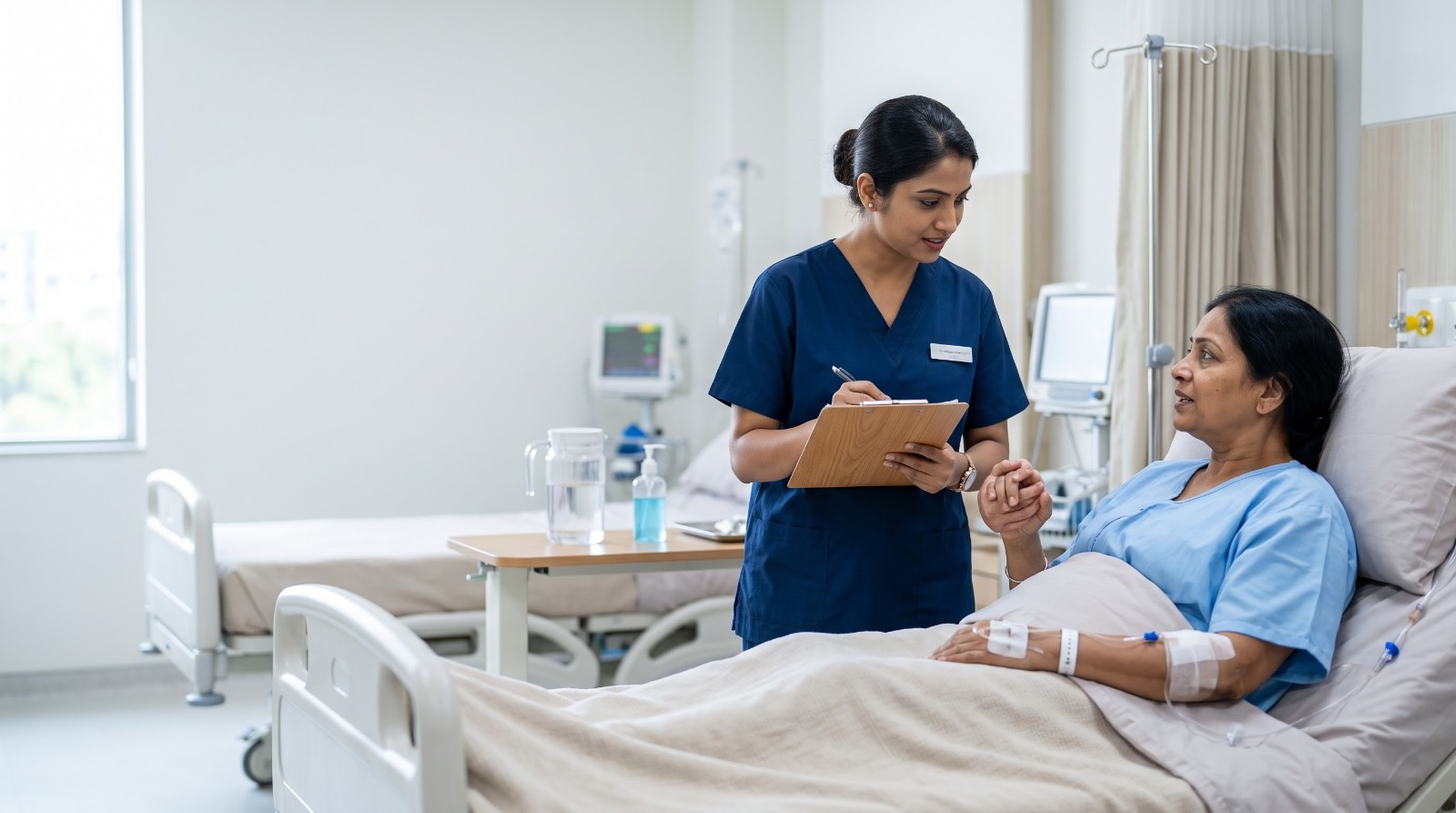
Nursing Care Plan for Pain: A Complete Guide for Families and Home Nursing
Understanding Pain and the Role of Nursing Care

Pain is described by the International Association for the Study of Pain as an unpleasant sensory and emotional experience linked with, or resembling that linked with, actual or potential tissue damage. It is one of the most common reasons families seek nursing support at home.
Pain can be acute or chronic. Acute pain usually follows surgery, an injury or an illness and is expected to settle within a few months. Chronic pain continues for longer, often beyond three months, and may not have a predictable end point.
Because pain feels different for every person, managing it well takes more than a tablet at a fixed time. It calls for watching how the patient responds, noticing small changes, and adjusting care as recovery moves forward.
Nurses play a central role here. They assess how severe the pain is, give medicines exactly as prescribed by the treating doctor, track vital signs, and flag anything that looks like it needs medical attention.
This is exactly what a nursing care plan is meant to do: turn a doctor's prescription into a day-to-day routine that is built around the patient's own symptoms, condition and pace of recovery, rather than a one-size-fits-all schedule.
For patients who need this kind of continuous attention but do not need to stay admitted, home nursing offers a way to get monitoring, medication support and comfort care from a qualified nurse, in familiar surroundings.
What Is a Nursing Care Plan for Pain?
A nursing care plan is simply a written, structured plan that tells the care team what to assess, what to aim for, and what steps to take for a specific patient. For pain, it turns a doctor's prescription into a practical day-to-day routine.
Most pain care plans are built around five parts:
| Component | What It Covers |
|---|---|
| Assessment | Location, severity, duration and nature of the pain |
| Nursing diagnosis | Identifying the patient's pain-related nursing needs |
| Goals | Reducing pain and improving comfort or function |
| Interventions | Medication support, positioning, comfort measures and monitoring |
| Evaluation | Checking whether the interventions are actually working |
This structure is not unique to hospitals. The same five steps apply just as well to nursing care given at home, which is why families increasingly ask for a written plan even for home-based pain management.
Pain Assessment in Nursing
What Does a Nurse Assess When a Patient Has Pain?
Nurses commonly use the PQRST framework (Provocation, Quality, Region, Severity, Timing) to build a complete picture of a patient's pain rather than relying on a single number.
- Location of the pain and whether it spreads elsewhere
- Severity or intensity, usually rated on a scale
- Type and character, such as sharp, dull, burning or throbbing
- Duration of each episode and how long the pain has existed overall
- Onset, whether it began suddenly or built up gradually
- Factors that make it worse or bring relief
- Impact on sleep, appetite and daily activities
- Associated symptoms, such as nausea, breathlessness or fatigue
- How the patient responded to earlier pain-relief measures
Pain Assessment Scales
The Numerical Rating Scale (NRS) asks the patient to rate pain from 0 (no pain) to 10 (worst imaginable pain), and is the most widely used bedside tool.
The Verbal Rating Scale asks patients to describe their pain using words such as mild, moderate or severe, instead of a number.
The Visual Analogue Scale (VAS) uses a straight line between "no pain" and "worst pain," and the patient marks the point that matches how they feel.
For patients who cannot communicate clearly, such as young children, people with advanced dementia, or those who are sedated, nurses turn to observational tools like the Wong-Baker FACES scale, the FLACC scale, or the PAINAD scale, which score facial expression, body language and behaviour instead of relying on verbal answers.
These scales help track whether pain is improving, but they are tools for monitoring, not for deciding treatment on their own. Any change in medication or dosage still has to come from the treating doctor.
Nursing Diagnosis for Pain
A nursing diagnosis is a clinical judgement about how pain is affecting a specific patient, based on the assessment findings. It gives the care team a focused problem statement to plan around, rather than a general note that "the patient has pain."
Depending on the assessment, a nursing diagnosis for pain might centre on:
- Acute pain, typically tied to a recent injury, surgery or illness
- Chronic pain, linked to a long-term or recurring condition
- Pain affecting mobility or the ability to move safely
- Pain affecting sleep or the ability to carry out daily activities
- Pain associated with surgery, an injury, or an underlying medical condition
The exact diagnosis used always depends on the individual assessment and the treating doctor's clinical picture. It is not something that can be assumed in advance from a general description of symptoms.
Goals of a Nursing Care Plan for Pain
Good goals are specific to the patient and can actually be checked, rather than vague statements like "patient feels better." Some examples nurses commonly work towards:
- Patient reports improved comfort
- Pain is monitored regularly and consistently
- Patient is able to rest or sleep more comfortably
- Patient can participate in appropriate movement or daily activities
- Prescribed medication is administered safely and its effects are monitored
- Changes in symptoms are identified and communicated promptly
- Patient and family understand what the care plan involves
At home, managing pain often needs more than occasional help. A personalised nursing plan supports families in keeping medication schedules on track, watching for changes, and knowing when those changes need a doctor's attention.
Nursing Interventions for Pain Management
Regular Pain Assessment
- Monitor pain at the intervals set out in the care plan
- Record changes in pain intensity over time
- Watch for changes in behaviour, mobility, sleep or appetite
Administering Prescribed Medication
- Give medicines exactly as prescribed by the treating doctor
- Follow the prescribed timing and dosage without deviation
- Monitor how the patient responds after each dose
- Watch for possible side effects and report concerns to the doctor promptly
Positioning and Comfort Measures
Depending on the patient's condition, this can include:
- Positioning that reduces pressure on the affected area
- Supporting the affected limb or joint
- Comfortable, well-maintained bedding
- Assisting with safe, controlled movement
Supporting Mobility
Appropriate help with movement matters a great deal for patients in pain, particularly after surgery or during recovery from an injury. Moving too little can slow recovery, while unsupported movement can worsen pain, so this is usually guided by the treating doctor or physiotherapist.
Non-Pharmacological Comfort Measures
Where the clinical situation and medical advice allow, these can be used alongside medication:
- Relaxation techniques
- Breathing exercises
- Appropriate massage
- Distraction and diversional activity
- A calm, comfortable environment
- Support for rest and sleep
Monitoring and Documentation
Nurses document pain-related care carefully, because it is what lets the whole care team, and the treating doctor, see the full picture:
- Pain levels at each assessment
- Interventions provided and when
- Medication administered, including timing and dose
- Patient's response to each intervention
- Any changes in symptoms
Escalating Changes in Condition
A nurse's role is not only to manage expected pain, but to notice when something has changed. Significant changes should be communicated to the family and treating doctor right away, and urgent medical attention should be sought where the situation calls for it.
Nursing Care Plan for Acute Pain
Acute pain care plans commonly apply to:
- Post-operative pain
- Injury-related pain
- Pain following a medical procedure
- Pain from an acute illness
A typical structure follows five steps in sequence:
| Step | What Happens |
|---|---|
| Assessment | Location, severity, character and pattern of the pain are recorded |
| Nursing diagnosis | A specific pain-related diagnosis is identified from the assessment |
| Goals | Measurable comfort and function targets are set for the patient |
| Interventions | Medication, positioning and monitoring are put in place |
| Evaluation | The plan is checked and adjusted based on the patient's response |
During recovery at home, short-term nursing support such as post-operative nursing care can help a patient follow this exact structure, with a nurse tracking pain alongside wound healing and mobility.
Nursing Care Plan for Chronic Pain
Chronic pain is different from acute pain in how it is managed. It is usually tied to a long-term condition, tends to recur, and can affect mobility, sleep and quality of life over months or years rather than weeks.
- Long-term conditions contributing to ongoing pain
- Recurring pain episodes rather than a single event
- Reduced mobility over time
- Disrupted sleep and lower quality of life
- The need for consistent medication adherence
- Ongoing monitoring rather than a fixed treatment window
Chronic pain management usually needs coordination with the patient's existing doctors and specialists, since the underlying condition is often being treated in parallel.
This is where ongoing home nursing support tends to help most. A dedicated CareManager can oversee the case over time, rather than leaving a family to re-explain the patient's history to a new person every visit.
Nursing Care Plan for Pain After Surgery
Pain care after discharge typically covers:
- Ongoing pain assessment after leaving hospital
- Support with prescribed medication timing and dosage
- Wound observation alongside pain monitoring
- Safe, supported mobility
- Adequate rest
- Watching for changes that need medical review
- Knowing when to contact the treating doctor
Families managing recovery at home can lean on a structured post-operative care at home service, where a nurse manages pain, wound care and mobility together instead of as separate concerns.
When Pain May Require Urgent Medical Attention
Some pain is a sign of a medical emergency and should never be managed at home while waiting it out. This includes:
- Sudden or severe pain that has no clear explanation
- Chest pain
- Severe difficulty breathing occurring alongside pain
- New neurological symptoms, such as weakness, slurred speech or facial drooping
- A significant drop in consciousness or responsiveness
- Severe pain following a serious injury
- Pain accompanied by concerning symptoms such as significant bleeding
When is pain an emergency?
If pain is sudden, severe, unexplained, or comes with serious symptoms such as difficulty breathing, loss of consciousness, significant bleeding or new neurological signs, seek urgent medical attention rather than relying on home nursing support.
senOcare home nursing is built for planned and ongoing care. It is not a substitute for emergency medical treatment.
When Is Home Nursing Care Appropriate for a Patient With Pain?
How Home Nursing Can Support Pain Management
Home nursing tends to fit naturally into pain management when a patient is:
- Recovering after surgery
- Elderly and experiencing mobility difficulties
- Living with a chronic condition
- Needing regular, correctly timed medication
- Recovering after a hospital stay
- Requiring wound care alongside pain management
- Needing ongoing monitoring at home
- Part of a family that cannot provide round-the-clock support alone
This is where senOcare's model is built around three things: care shaped by the patient's actual condition, qualified and background-verified nurses at the patient's home, and a dedicated CareManager who stays the family's single point of contact throughout the case.
What Does Home Nursing Care for Pain Include?
| Nursing Support | How It Helps |
|---|---|
| Vital monitoring | Helps track changes in the patient's condition |
| Medication administration | Supports adherence to the prescribed schedule |
| Mobility assistance | Helps patients move safely |
| Hygiene support | Helps maintain comfort and personal care |
| Wound care | Supports post-operative or wound-management needs |
| Pain monitoring | Tracks changes and response to care |
| Family communication | Keeps family informed about important changes |
| Doctor coordination | Helps communicate concerns to the treating team |
senOcare provides home nursing across Delhi, Gurgaon, Noida and Faridabad, with the care plan adjusted to each patient's own requirements rather than a fixed package.
Related Nursing Care Plans for Different Conditions
Other Nursing Care Plans You May Find Helpful
Pain often shows up alongside other medical conditions. Understanding the nursing care plan for the underlying condition can help families see what ongoing care may actually involve.
Nursing Care Plan for Fever
Fever care centres on monitoring temperature, hydration, associated symptoms and how the patient responds to prescribed treatment. senOcare's nursing care plan for dengue fever walks through this in a related context.
Nursing Care Plan for Anaemia
Anaemia-related nursing care usually involves monitoring symptoms such as fatigue and breathlessness, supporting medication adherence, following nutrition guidance as prescribed, and watching for changes in the patient's condition. A dedicated post on this topic is planned as part of this content series.
Nursing Care Plan for Diabetes
Diabetes care at home typically covers regular monitoring, medication support, following prescribed diet and meal routines, foot care, and recognising early signs of complications. This is also planned as an upcoming addition to this series.
Further additions planned for this series include nursing care plans for stroke, dementia, wound care, post-operative recovery and critical care, building out a fuller library of condition-specific guidance.
Home Nursing Care Services in Delhi, Gurgaon, Noida and Faridabad
Home Nursing Care Services Near You
Professional nursing support can make recovery and long-term care considerably easier for families who need personalised attention at home. senOcare provides home nursing services across Delhi, Gurgaon, Noida and Faridabad.
Nursing Care in Delhi
senOcare's Delhi nursing care service covers areas including Vasant Kunj, Greater Kailash, South Extension, Dwarka and Rohini.
Nursing Care in Gurgaon
senOcare's Gurgaon nursing care service covers DLF Phases 1 to 5, Sohna Road, Sector 56, South City and Golf Course Road, with vitals monitoring, medication support and coordination with the patient's treating doctor.
Nursing Care in Noida
senOcare's Noida nursing care service ranges from daily nursing visits through to full-time support for post-surgery or chronic-care requirements.
Nursing Care in Faridabad
senOcare extends the same verification and nursing-care standards to Faridabad as it does across its other service locations.
Why Choose senOcare for Nursing Care at Home?
Qualified and Background-Verified Nurses
Families can review a nurse's credentials and verification before care begins, rather than meeting them for the first time on day one.
Personalised Nursing Care
Care is selected around the patient's condition, schedule and specific requirements, rather than a standard package applied to everyone.
Dedicated CareManager
One CareManager oversees the case from start to finish, so the family is not left coordinating between multiple people for the same patient.
Flexible Care
Shift length, the assigned nurse, and the scope of care can all be adjusted as the patient's requirements change over time.
Support Beyond Basic Attendant Care
Nursing care goes beyond companionship or basic attendant support. It covers clinical needs such as medication administration, vitals monitoring, wound management and higher-need care where appropriate.
How to Book Home Nursing Care With senOcare
Step 1: Share the Patient's Requirements
Tell the team about the patient's condition, location and the hours of care required.
Step 2: Get a Dedicated CareManager
The CareManager reviews the case and identifies a suitable nurse for the patient's needs.
Step 3: Review Nurse Credentials
The family receives the nurse's background and credentials before care begins.
Step 4: Start Nursing Care
Care begins according to the schedule agreed with the family.
Step 5: Adjust Care as Needed
The care plan, the nurse, or the shift requirements can be adjusted as circumstances change.
Need personalised nursing care at home? Talk to senOcare about your requirements.